

What would you do in case the process of contract creation could be quicker, easier, and more precise?
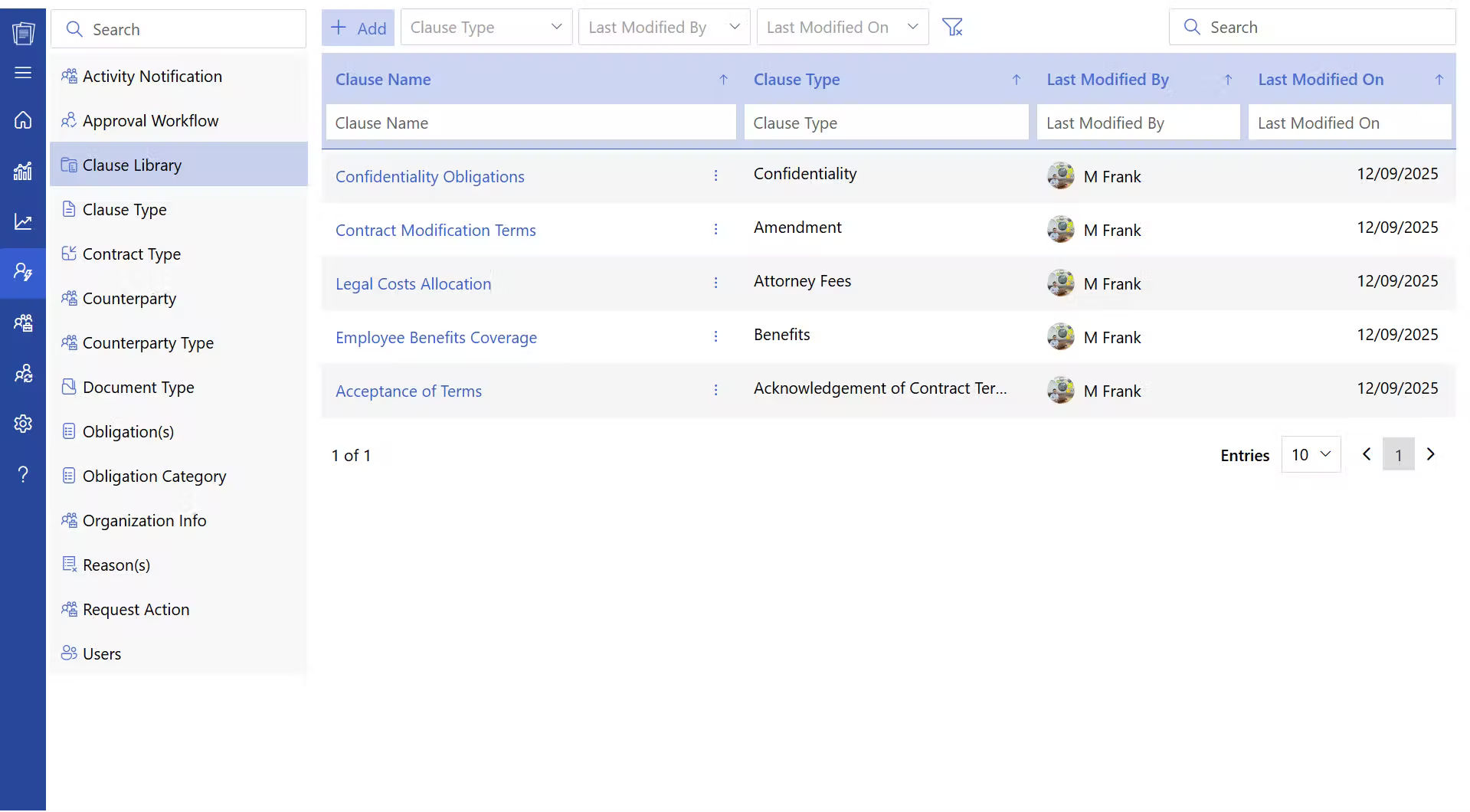
- A clause library stores approved contract clauses in one central location, making them easy to find and reuse.
- Teams can create contracts faster by inserting pre-approved clauses instead of drafting language from scratch.
- Using standardized clauses helps improve contract consistency and reduces legal and compliance risks.
- A well-organized clause library minimizes manual searching, saving time for legal, procurement, and business teams.
Clause library have been assisting legal teams over the years. They store pre-approved clauses that you can quickly reuse, so you don’t have to start every contract from scratch.
You do not need to repeat the same words repeatedly, just choose the appropriate clause and insert it into your contract. This will save time, minimize mistakes, and maintain your records.
This guide will examine the functionality of clause libraries and how they can make contract drafting faster and more efficient
What Is Clause Library?
Key Clauses Every Contract Should Have
Understanding the right correct contract clause to put in a contract assists you to write clear, strong and reliable contracts. It enhances clarity, reduces risks, and makes it all legally sound. These are some of the key clauses that any contract ought to have.
1.Confidentiality Clauses
The confidentiality provisions are used to safeguard important information that is exchanged between the two parties like business plans, financial information or trade secrets. They make sure that sensitive contract information is not lost and is utilized as consented to, which fosters trust and professionalism. This also makes both sides assured to give information without misusing it.
2. Force Majeure Clauses
The force majeure clauses are clear in the case of unexpected events such as natural calamities, pandemics, or political transitions. They provide a just means of dealing with such incidences and both sides are safeguarded when things get out of control. This will prevent conflicts in challenging and unpredictable circumstances.
3. Indemnification Clauses
Any responsibility is well established in indemnification clauses in the event of any problem. They make sure that the appropriate party bears the losses or damages, to facilitate fairness, accountability, and healthy business relations. This provides an additional cover against financial and legal risks.
4. Termination Clauses
Termination clauses provide an effective and orderly manner of terminating a contract when necessary. They define terms of condition, time of notice, and any other terms, and make the departure of both parties a smooth and transparent contract process. This assists the two parties in strategizing and preventing misunderstandings when closing the contract
5. Payment Clause
Payment clauses are clear on how and when payments are to be made. They contain information such as payment terms, due dates and methods, and both parties understand their financial expectations. This would prevent delays, misunderstandings and a stable and reliable cash flow.
Benefits of Using Contract Clause Library
According to a study by Deloitte, 91% of individuals do not read terms before accepting and among the ages of 18 to 34, it increases to 97%. This further emphasizes the need of businesses to prepare clear, reliable and well-structured contracts. This is how a library of clauses can really help your business.
1. Saves Time and Improves Efficiency
It may be time-consuming to make contracts individually on a case-by-case basis. Teams tend to repeat writing the same clauses or going through previous documents to get the correct wording. Your team can find the pre-approved clauses faster and construct contracts much faster with a clause library.
Speed up Your Contract Process with Automation
1. Saves Time and Improves Efficiency
It is important to be consistent in language used in contracts to prevent confusion and ensure professionalism. The use of different versions of the same contracts may result in misunderstanding or gaps in agreements. A clause library is used to make sure that all contracts use the same approved language.
3) Reduces Legal Risks
The use of unclear words or obsolete provisions may cause conflict and loss of confidence. A clause library can minimize these contract risk by offering already reviewed and approved clauses that have been reviewed by legal professionals. This will keep your contracts in check, correct and in line with your companies’ legal standards.
4) Supports Non-Legal Teams
As per WCC, 90% of professionals find contracts either difficult or downright impossible to understand. Employees who handle contracts are not necessarily lawyers, but most departments such as HR, sales, and procurement must prepare or handle contracts on a regular basis. The software assists in drafting contracts without having to hire legal teams to do every minor modification, which enhances productivity within the departments.
5) Adapts to Different Business Needs
Each contract can be different depending on the client, industry, location or type of deal. It is not always effective to use the same wording in all situations. A clause library enables you to have various clauses that can be used in different situations. The efficient is facilitated by this flexibility that allows your team to tailor contracts rapidly with trusted, approved content.
How many contracts does it take to find the right clause?
With CLM 365, just one search. Find and reuse approved clauses in seconds.
Best Practices for Using the Clause Library
An effective clause library enables teams to operate more efficiently, be in sync and produce superior contracts. The following are some of the practical methods of making the most out of it. The following are some of the best practices.
1. Organize Clauses with Clear Categories
Begin by organizing clauses in a simple and rational manner to make them easily accessible to users. By grouping clauses appropriately, the library can be easily used by both legal and non-legal teams.
- Divide clauses into groups based on purpose, e.g., Confidentiality, Payment Terms, Termination, and Liability.
- Add subcategories of cases such as Vendor Agreements or Client Contracts.
- Name and label things in a way that anyone can comprehend and select the appropriate clause.
2. Review and Update Clauses Regularly
Regular contract review helps keep your clauses aligned with current laws, company rules, and market needs. By reviewing clauses at set intervals, your clause library stays useful, accurate, and ready for ongoing contract work.
- Have a legal team member to go through clauses on a set basis, such as once a quarter
- Modify old clauses and delete unnecessary clauses
- Keep older versions in a different place to keep the main library clean and up to date
3. Use the Right Tool or Platform
The contract management software you use is significant in the ease at which your team can access and utilize the clause library in their day-to-day operations. A well-designed and simple system will motivate people to use it on a regular basis and teams.
- Select a tool that allows a fast search, tagging, and access control.
- Maintain a clean interface to enable users to navigate without challenges.
- Pilot the platform using a small sample and then implement it to all.
4. Use AI and Automation to Save Time
A 2025 Adobe survey found that 91% of U.S. small and medium-sized business owners work with contracts monthly, yet many don’t fully understand the terms. This shows the need for better support while drafting contracts.
- AI to propose appropriate clauses depending on the contract type.
- Allow the system to point out obsolete or inappropriate content.
- Auto-fill frequently used clauses to save time and work.
5. Train Your Team to Use It Well
Although clause libraries are user-friendly, some training materials can enable teams to know how to use it more efficiently and achieve better outputs in their daily activities.
- Do brief training to demonstrate the work of the library.
- Provide easy-to-follow instructions and practical examples to use daily.
- Discuss how it assists in time savings, risks reduction, and work quality enhancement.
Common Mistakes to Avoid When Using a Clause Library
A clause library will save time and simplify contract work, but the value of a library of clauses lies in its utilization and maintenance. Paying attention to a few common gaps can help teams get better results and make the clause library more useful in daily work.
1. Keeping Clauses Without Regular Updates
A clause library is most effective when the material remains up to date. Laws, company policies and market practices are subject to change with time. Without reviewing clauses, teams can find themselves using old content in new contracts. A simple review cycle, such as quarterly or biannual, can be used to maintain the clause library
2. Limited Collaboration Across Teams
One team should not create a clause library. They may be developed by legal teams, but are frequently used by sales, procurement, and operations teams. Without their input, the clause template might not be compatible with actual use cases. The clause library can be more practical and easier to use during contract collaboration.
3. Overcomplicating Clause Language
Using complex language in a clause library can slow down understanding. Not all people reading the contract are lawyers and simple wording makes people comprehend quicker. Direct and clear clauses enable easier discussions and less time wastage in contract review.
4. Lack of Proper Categorization
Without a well-organized clause library, users will take more time to find clauses. This reduces its overall value. Categorizing, tagging, and labelling simplifies the process of locating the appropriate clause in a short period of time. Daily usage can be enhanced by grouping clauses by type, industry, or use case.
5. Not Encouraging Consistent Usage
A library of clauses is only valuable when it is used on a regular basis by teams. There is the possibility that some of the team members will still use old documents or personal drafts rather than the library. Training, quick guides, or reminders can encourage regular use to ensure that teams adopt the clause library and are consistent across contracts.
Key Metrics to Track Clause Library Performance
Measuring the correct metrics can assist you in knowing the quality of usage of your clause library and areas that need to be improved. The insights help facilitate easier usage, time savings, and promote improved contract outcomes.
- How often clauses are used across different teams
- Time taken to find and insert clauses into contracts
- Reduction in overall contract drafting time
- Number of updates made to keep clauses current
- Time taken for clause review and approval
- Consistency of clause usage across contracts
- Reduction in legal or compliance-related issues
- Number of active users engaging with the clause library
How AI Improves Clause Management?
AI is transforming the way teams manage contracts by making clause management quicker, simpler to comprehend, and more practical to both legal and non-legal consumers.
- Summarizes long contract sections into short, easy-to-read points
- Highlights risks and helps track important obligations within clauses
- Suggests updated and relevant clauses based on industry practices
- Helps non-legal teams understand contracts in simple language through AI agents
- Speeds up the overall contract review process
CLM 365: Better way to Manage Clause
CLM 365 is developed on the Microsoft platform and can be connected to such tools as Microsoft SharePoint, Microsoft Teams, Microsoft Outlook, Microsoft Copilot, Power BI, and Power Automate. This enables the teams to handle contracts in the tools that they use daily.
The AI-powered workflows can manage approvals, obligation tracking, and compliance activities, eliminating the necessity of manual follow-ups and assisting teams in keeping track.
The platform is designed with high security and easy to use interface, which is applicable to both emerging businesses and big companies.
Its built-in library of clauses and templates that are ready to use mean that users can rapidly develop draft agreements without relying on legal teams as much, making the process faster and more accessible to all.
Conclusion
Having a well-organized library of clauses is not merely a location to store content; it is a significant part of your team managing contracts daily. It assists teams to work quicker, maintains contract conditions constant and aids in enhanced risk management.
When the library is easy to access, clearly organized, and regularly updated, it becomes a reliable part of your contract process. Start your 14-day free trial and explore the clause library of CLM 365 in action.
Frequently Asked Questions
What is a contract clause?
A contract clause is a specific part of an agreement that explains one detail of the deal. It can cover rights, duties, or conditions that both parties agree to follow. Each clause has its own purpose and carries legal importance within the contract.
What does a clause mean in a legal documents?
In legal documents, a clause is a separate section that focuses on a single point, such as a responsibility, right, or rule. It helps break down the contract into clear parts so both parties understand what is expected from them.
How to draft an agreement clause?
To write a clause, start by defining the exact point you want to cover. Use simple and direct language to explain what each party should do or follow. Keep the wording clear so there is no misunderstanding, and check that it fits well with the rest of the agreement and follows applicable laws.
What is the term clause of a contract?
A term clause explains how long the contract will remain active. It may include the start date, end date, and any conditions for renewal or extension. This clause helps both parties know the duration of their agreement.
What types of clauses are stored in a clause library?
A clause library includes common clauses like payment terms, confidentiality, termination, liability, and dispute resolution. It may also have industry-specific clauses, making it easier to use the right content for different contracts.
Can non-legal teams use a clause library?
Yes, non-legal teams can use a clause library when it is clearly written and well organized. With basic guidance, teams like sales or procurement can use approved clauses without relying fully on legal teams.
Table of Contents

Trusted by the Best

_JiluXJRGNl.svg)