
In case you have a job in the legal, sales, procurement, or HR, you can spend hours reading contracts and still fail to locate the most important details.
This does not only waste time but also exposes one to the risk of overlooking crucial clauses, obligations or even deadlines.
Contract summary software uses AI to read contracts and show the important points. It saves time and helps teams avoid mistakes.
AI-based contract summary software comes in here. Rather than having to read a document line after line, AI can scan the contract and display an easy-to-understand summary of the important terms, responsibilities, risks, and dates.
According to Thomson Reuters, 53% of organizations say they are already experiencing at least one benefit from adopting AI. Contract summarization is one of the most practical examples, helping teams reduce manual effort, improve accuracy, and focus on higher-value work rather than paperwork.
What Is Contract Summary Software
Contract summary software scans a contract and prepares a concise summary of key points in the contract in a clear and short form. Users could view important clauses, duties, risks, payment terms, renewal dates and termination terms in a few seconds instead of going through lengthy legal documents.
The software summarizes contract, finds the relevant parts, and displays the information in a plain language. The users can choose certain clauses and receive immediate explanations, thus making contracts simpler to comprehend without being a lawyer.
How Does Contract Summary Software Work?
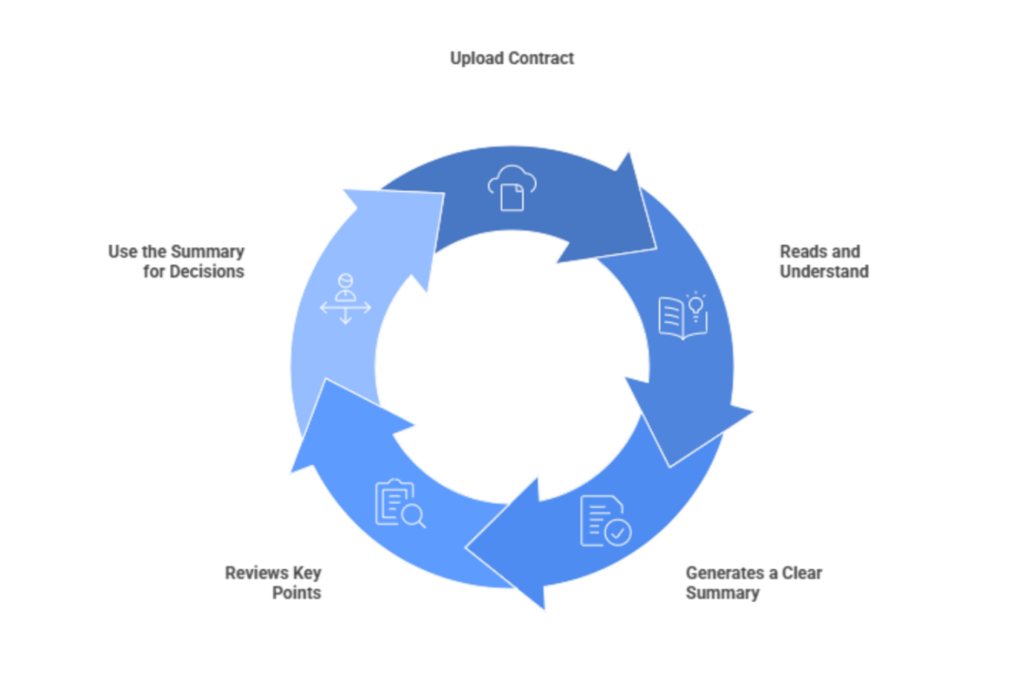
Contract summary software assists the team to get a quick grasp of long contracts by converting them to short clear summaries. It does not require one to read through each page yet still get the most significant information.
Step 1: Upload the Contract
The contract file is uploaded by the users and normally in PDF or Word format. The program scans the document without altering the original document.
Step 2: Review and Interpret the Contract
The system reads review the contract and comprehends the meaning of each part. It determines such vital details as major clauses, obligations, deadlines, renewal conditions, and termination conditions.
Step 3: Create an Explicit Overview
The software develops a systematic overview that brings out the key points of the contract. The users can easily view what the contract is, what they are supposed to do and what they need to be attended to.
Step 4: Review Key Points
The summary is reviewed by teams to ensure accuracy. When necessary, they can press on certain clauses to see the explanations in a simple language.
Step 5: Decision Support: The Summary
After being reviewed, the summary is used by the teams to approve, negotiate or manage the contract. This makes them take less time to read the entire document once more.
Key Features of Contract Summary Software
With organizations handling larger volumes and complexity of contracts, most are seeking smarter contract summary methods particularly as corporations anticipate doubling their AI expenditure in 2026, rising to 0.8 to approximately 1.7 percent of total revenues, which is a definite move towards quicker and more precise contract summaries.
1. Clear Clause Summaries in Plain Language
The software converts the lengthy and complicated legal contract clauses into concise summaries that dwell on the essence of every section. Users do not have to read pages of legal text to get a quick grasp of what a clause says, what it permits and what it requires. These summaries assist the teams to review contracts quicker and less effort is required to comprehend legal language.
2. Suggests Alternate Wording for Clauses
In case a clause seems vague, restrictive or not applicable to the needs of business, the software suggests alternative wording. These recommendations enable teams to contrast various drafts of a clause and select language more accurately. This helps in the improved review and negotiation prior to the contract proceeding.
3. Up-to-Date Clauses Based on Industry Standards
The software matches the clauses of the contract with the frequently used language in other related industries. This assists the users to know whether the wording is in line with the current business practices. The teams can recognize the clauses that might require consideration as they are either outdated or rare.
4. Early Identification of Contract Risks
The system identifies contract risks that can be either legal liability, monetary or operational liability. It raises awareness on issues like penalties, liability, termination conditions, and payment conditions. This enables the teams to examine the main areas of risk at an early stage during the contract review.
5. Interactive AI Agents for Clause Understanding
Users can choose any clause and pose questions in simple language. The contract summary software will clarify the meaning of the clause, its purpose, and the impact it can have on the organization. This capability eases the rapid learning process and assists non-legal users with comprehending the terms.
6. Helps Handle Contract Obligations
The contract summary software recognizes significant obligations, deadlines, and deliverables stated in the contract. It brings out what needs to be done and by whom. This assists the user to keep in touch with their duties and monitor key dates within the contract lifecycle.
7. Works Smoothly with Your Current Tools
The software integrates with the existing document systems, collaboration systems, and business applications. The software summarizes key details are available to the teams without altering the way they work. This enables the process of reviewing and tracking of contracts to be integrated into the day-to-day operations.
Benefits of Using AI-Based Contract Summary Software
Contracts are usually time consuming and attention consuming, particularly when the documents are in dozens of pages. The following are some of the advantages.
1) Smart Contract Summaries
The software scans through the entire contract and finds out the most crucial parts, such as key clauses, duties, payment terms, schedules, and conditions. It gives this information in a systematic summary, which is an indication of the real purpose of the contract. The users will be able to know what the contract entails, what they must do and what they must look at without having to go through every page of legal text.
2) Fast Access to Key Information
The process of contract review can be time-consuming, particularly when the documents are lengthy and have complicated language. Contract summary software generates summaries nearly instantly after upload. Teams can peruse important information in a shorter time, answer demands in a shorter time and proceed with approvals and negotiations without wasting time.
3) Better Risk Awareness
Contract terms can be cost, duty, renewal, or termination rights. The software identifies such clauses and draws the attention of the user at an early stage. This will enable the teams to go over the key terms, deliberate on the possible issues and make informed decisions prior to the deal being sealed.
4) Easier Team Collaboration
In case of contracts that are interdepartmental, the discussion may be slowed by the need to share full legal documents. Contract summaries provide access to clear information to everyone. Contract terms can be discussed by internal teams with a common understanding that will help align faster and make decisions more easily.
5) Easy to Understand for All Roles
Legal terminology may not be easy to understand by non-legal practitioners. Contract summary software is easy to read and understand. This will enable sales, HR, financial, and operations users to have a grasp of contracts independently and operate without the regular assistance of legal departments.
How Contract Summary Software Helps Non-Legal Teams
Contract summary software assists non-legal staff to comprehend contracts by transforming lengthy legal documents into concise summaries that are written in straightforward language, describe important terms and duties.
1. Makes Contracts Easy to Understand
Contract summary software shows significant clauses in a simple language. It describes what the contract entails, what each party is required to do, and what terms must be addressed. Contracts can be easily comprehended by non-legal users without legal training, and it is more practical to review contracts.
2. Reduces Dependency on Legal Teams
Legal departments are involved in complicated and high-impact reviews, yet not all contracts require urgent legal attention. Contract summary software enables non-legal departments to perform simple reviews independently. Teams can learn common terminologies and bring up only significant matters to legal and save time on behalf of all.
3. Supports Better Business Decisions
Clear contract summaries help teams make informed decisions.
- Sales teams review pricing, scope, and delivery terms
- HR teams understand employment conditions and policies
- Finance teams review payment terms and billing schedules
- Procurement teams check vendor obligations and renewal terms
4. Helps Teams Act on Key Responsibilities
The contracts contain activities which should be undertaken by certain teams. Contract summary software identifies important duties, deadlines and milestones. Non-legal teams know what to do and when without going through lengthy documents. This assists teams to remain on course with the contract and prevent tasks missed.
5. Empowers Proactive Contract Management
Contract summary software assists teams to remain conscious of the contract terms during the contract period. Users review summaries, monitor responsibilities and keep track of significant dates. This helps in planning and acting on time as opposed to acting late. Contracts can be handled by teams as part of everyday work and not as a one-time review.
Contract Summary Software vs Manual Contract Review
Reviewing of contracts manually takes time, effort and specialization. Research indicates that the cost of reviewing and processing a low-complexity agreement might reach up to 6,900, which is mostly because of time wasted by legal and business teams. Here is a short comparison.
| Aspect | Manual Contract Review | Contract Summary Software |
| Time Required | Hours or days to read full contracts | Key details available within minutes |
| Cost Impact | High review effort for even simple agreements | Lower review effort and reduce cost |
| Understanding | Requires legal expertise | Easy to understand for all roles |
| Risk Visibility | Risks identified late in the process | Key risk areas highlighted early |
| Team Dependency | Heavy reliance on legal teams | Supports independent review by business teams |
Best Practices for Using AI to Summarize Contracts
The summaries of contracts based on AI assist teams to comprehend agreements quicker, yet the outcomes are better when users adhere to several structured practices. These best practices describe how teams can have better summaries, act on important information, and handle contracts better.
1. Upload Complete and Final Contract Documents
A contract summary is determined by the quality of the document presented. The uploading of full and final contracts assists the system to avoid missing any significant terms and duties.
- Use the latest or the last version of the agreement
- Including all pages, annexures and schedules
- Do not post drafts that have gaps
2. Review the Summary Promptly
Contract summaries are fast to get a glimpse of, however, reviewing them prior to acting assists teams to remain in line with business expectations and contract intent.
- Approve or sign before reading the summary
- Verify such key words as scope, payment, and timelines
- Compare business expectations with summary points
3. Assign Ownership to Key Obligations
Contracts typically contain various activities that must be accomplished by various teams. These responsibilities may be neglected without proper ownership. Ownership allocation assists teams to know who is to perform every task stated in the contract.
- Give the tasks to the appropriate team or owner
- Determine what must be done in the summary
- Monitor activities during the contract
4. Track Important Dates Highlighted in the Summary
Dates are also common in contracts, and they directly influence business results, e.g. renewals, notice, and delivery dates. Having these dates in sight aids teams to plan and do things when they are timely and not when they are late.
- Record the date of renewal of the note and notice period
- Monitor milestones and delivery schedules
- Check the deadlines of reviews on a regular basis
5. Involve Legal Teams for High-Risk Terms
Summaries of contracts assist in the entire early review of teams, yet there are still clauses that need legal knowledge. Engaging legal teams in the appropriate moment assists in dealing with complicated or high-impact terms without stalling the whole review procedure.
- High-risk flag clauses
- Only provide pertinent parts to legal teams
- Summaries can be used to assist in quicker legal review
6. Update Summaries When Contracts Change
Contracts usually undergo modifications in terms of amendments, renewals or renegotiations. The issue of updating summaries with each change aids teams to operate with correct and up-to-date information during the contract lifecycle.
- Post revised or amended contracts
- Check revised summaries with changes
- Remove outdated versions from active use
Getting Contracts Summarized with CLM 365
CLM 365 is developed based on the Microsoft ecosystem and integrates with other tools, including SharePoint, MS Copilot, MS Teams, MS Word, Power BI, and Power Automate, enabling teams to access and work with contracts within the systems already in use.
In addition to these integrations, CLM 365 offers concise contract summaries that are placed next to major obligations, milestones and ownership information. Teams have an opportunity to examine summarized terms of the contract, comprehend the duties, and track significant dates without accessing the full documents.
This assists in keeping the departments in line, responding to contract requirements in a timely manner, and managing contracts across their lifecycle on a single platform.
Future of AI-Driven Contract Summarization
With the ever-increasing volume of contracts, companies require quicker and more feasible means of comprehending contracts. AI-based contract summarization is shifting towards more advanced understanding of clauses, more intelligent obligation monitoring, and enhanced support of non-legal users.
Future developments will focus on more accurate summaries, clearer risk identification, and improved guidance throughout the contract lifecycle. With revenue losses reaching 9.2% annually due to poor contract handling, organizations are placing greater importance on tools that improve contract clarity and accountability.
Contract summary software will continue to play a key role in helping businesses protect revenue, improve decision-making, and manage contracts more effectively.
Conclusion
It transforms long and elaborate contracts into concise summaries that assist teams to save time and work more precisely. It helps teams understand things faster, whether you are going through customer agreements or vendor contracts.
When your company must work with several contracts every month, begin a 14-day free trial of CLM 365 and experience how a contract can be reviewed with ease.
Join Our Creative Community
Frequently Asked Questions
Is legal knowledge needed to use contract summary software?
No. Contract summary software is built for everyday business users. It presents contract details in clear language so non-legal teams can review and understand agreements without legal training.
What kinds of contracts can it summarize?
The software can summarize many contract types, including non-disclosure agreements, supplier and vendor contracts, employment agreements, service-level agreements, and other business documents.
Does it recognize legal clauses on its own?
Yes. The software automatically identifies common legal clauses such as confidentiality, termination, indemnity, payment terms, and renewal conditions without manual tagging.
Can CLM 365 compare two contracts?
Yes. CLM 365 allows users to compare two versions of a contract side by side and clearly shows what has changed between them.


_JiluXJRGNl.svg)